
Looking From a Different Angle
Resentment begins to change when a new design for living teaches us to see sickness instead of enemies.

The Alcoholics Anonymous Big Book says something on pages 66 through 68 that can change the way we live, if we are willing to let it.
It says, “We realized that the people who wronged us were perhaps spiritually sick. Though we did not like their symptoms, and the way those symptoms disturbed us, they, like ourselves, were sick too.”
That line asks me to see resentment from a different angle. It does not ask me to excuse harm. It does not ask me to deny what happened. It asks me to stop looking at people only through the old lens of injury, judgment, and retaliation.
That is a hard shift, but it is a healing one.
For the alcoholic, the program offers a new way of seeing.
The Big Book invites us to look at the people who wronged us differently. Not as enemies. Not as monsters. Not as people we need to defeat in our minds over and over again.
It asks us to pause long enough to consider that they may be spiritually sick too. That does not excuse what happened. It does not erase accountability. It simply changes the way resentment lives inside us.
It asks us to consider that they may be spiritually sick. They may be acting from fear, blindness, pain, pride, or a mind cut off from God.
Bill Wilson uses the word “sick” for a reason. When someone is sick, we see them differently. We may not like their symptoms. We may still need boundaries. But we do not usually argue with the illness as if reacting with anger would cure it.
That is the shift.
When a person offends me, the old alcoholic neural pathways of the affected mind want to build a case. It wants evidence. It wants witnesses. It wants to prove I was right and they were wrong. It wants to rehearse the injury until my whole body believes the story again.
As outlined in the Big Book, recovery offers a different response.
“This is a sick person. How can I be helpful? God save me from being angry. Thy will be done.”
That is not a weakness. That is a spiritual interruption.
For a few seconds, the old driver loses the wheel.
The deeper truth is not only that other people may be sick. The deeper truth is that I can be sick too, even when I am not drinking.
Sobriety removes the alcohol, but recovery has to rebuild the mind. Without new neural pathways formed through repeated practice, the old patterns can keep running. Fear can still drive me. Pride can still defend me. Control can still speak for me. Resentment can still convince me that I am right.
That is why recovery is more than abstinence. It is a new design for living. It teaches the brain, the body, and the spirit how to respond differently.
I may be sober, but if I am still ruled by the same old reactions, I am still living under the influence of self.
For many of us, the scenery changes, but the destination does not. Different relationships. Different jobs. Different towns. Different excuses. But the same inner collapse. The same anxiety. The same isolation. The same anger. The same three parking spaces, jails, institutions, and death.
Inventory is not punishment. It is a diagnosis.
It shows me where self has defeated me in different forms. It shows me where I have trusted a limited mind to solve an unlimited problem. It shows me where fear has been growing because I kept relying on the false center of selfishness and self-centeredness for safety, approval, control, and peace.
That is why inventory is such a mercy. It does not shame me. It helps me see it. It reveals the places where self has been trying to play God, protect me, manage people, control outcomes, and call it survival.
Once I can see that, I can stop defending the illness and begin surrendering the pattern.
On page 68, the Big Book suggests a quiet alternative: “Perhaps there is a better way.”
That alternative has saved my life more than once.
Perhaps there is a better way than retaliation.
Perhaps there is a better way than arguing.
Perhaps there is a better way than treating every offense like a personal attack.
Perhaps there is a better way than letting the illness make my decisions.
Recovery asks me to meet this moment cleanly.
That does not mean I become perfect. It means I become willing.
Willing to pause.
Willing to pray.
Willing to see sickness instead of enemies.
Willing to stop calling every reaction truth.
Willing to let God show me how to take a kinder and more tolerant view.
The promise is not that difficult people disappear. The promise is that I no longer have to be driven by them. I no longer have to be driven by self-will. I can feel the wound without worshipping it. I can tell the truth without becoming cruel. I can set a boundary without hatred.
That is freedom.
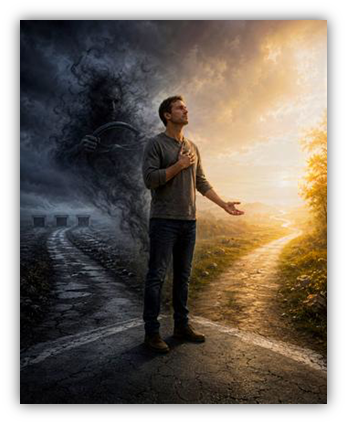
Not freedom from life, but freedom to meet life differently.
If this work resonates, you’re welcome to subscribe to Beyond the Basics: Embracing the Fellowship of the Spirit. There is a lot here to explore. You will receive a daily afternoon reflection, along with each morning’s latest piece delivered straight to your email.
Keep the Faith
Terry
